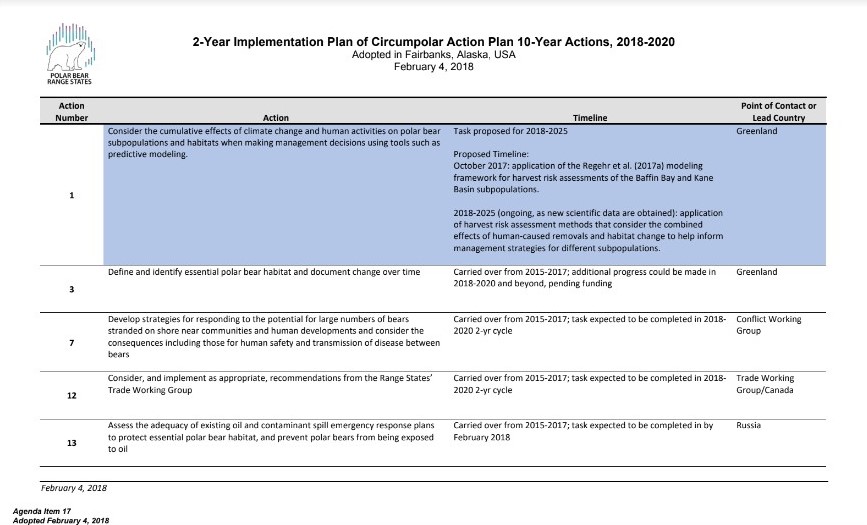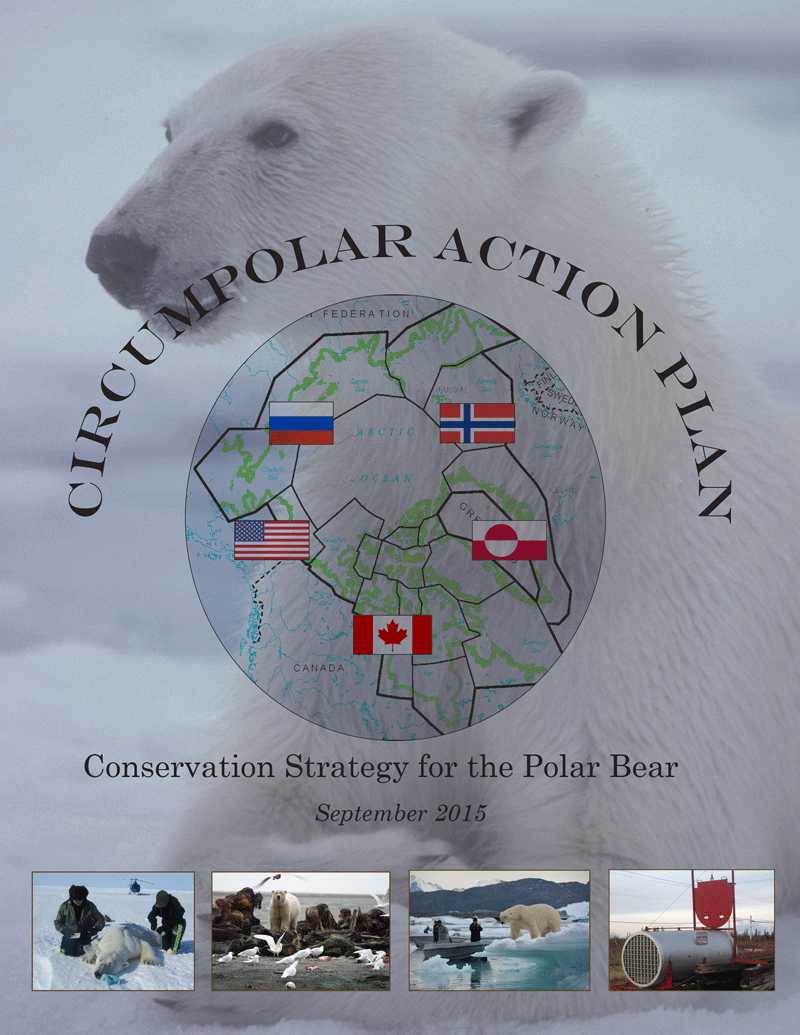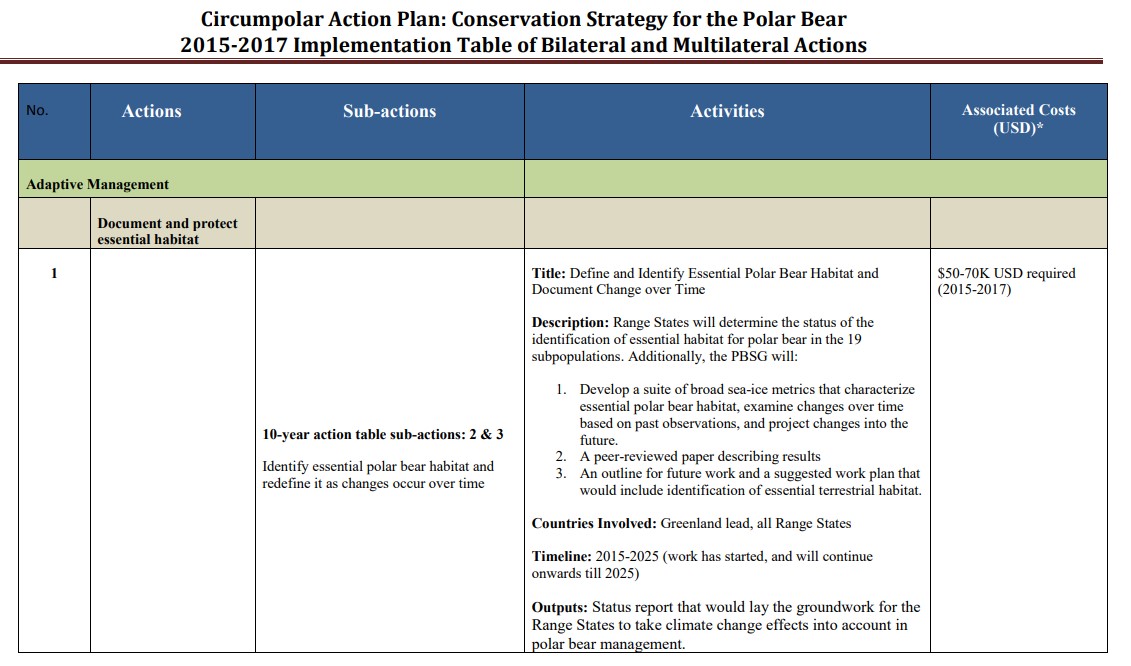
Progress on the 2015-2017 2-Year Implementation Plan was reported in November 2017 and is summarized below. The full report and individual reports can be found below.
2015-2017 Implementation Plan Overview (click on table to view the document in a pop-up window)
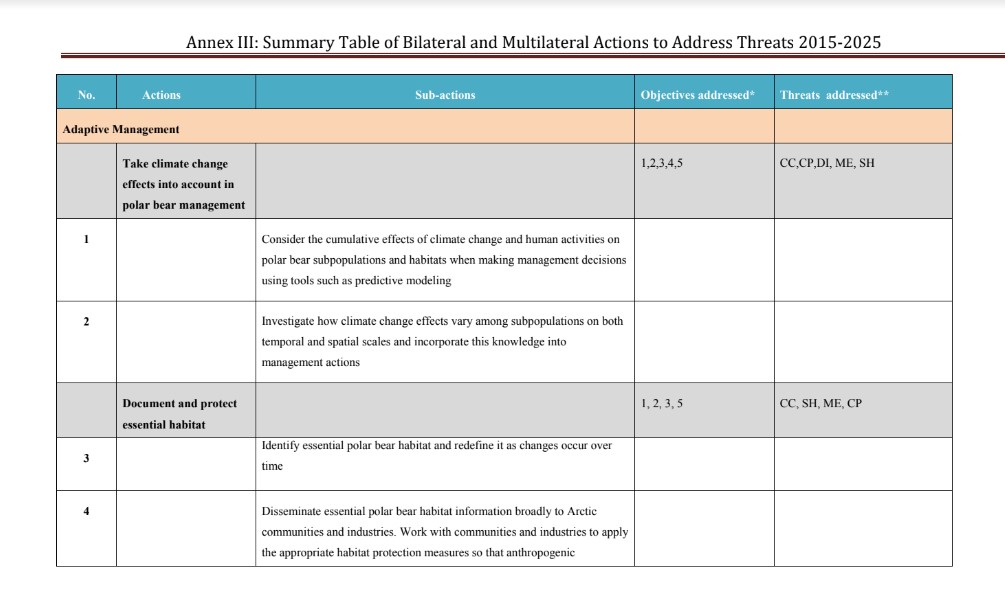
2015-2017 Implementation Plan Progress Reports
(Click on the icon to view the overall progress report. Report sections for each Action are provided in the relevant sections below)
List of Objectives and associated Actions of the CAP 2015 - 2027 implementation plan:
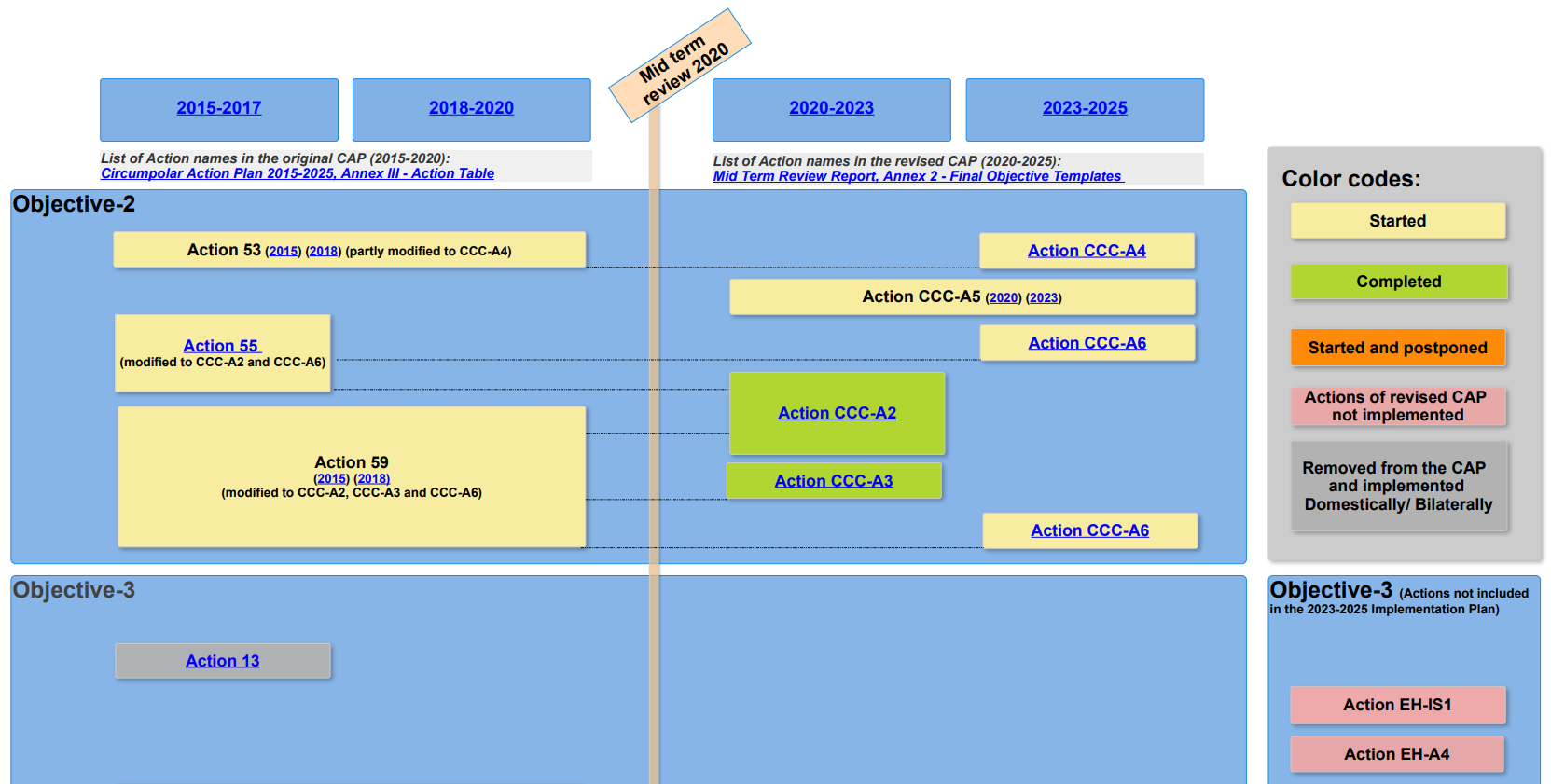
(The Actions were not directly associated with the CAP Objectives in the original 2015-2025 CAP. The categorization of the Actions by Objectives presented below is based on the in 2020; and ).
{slider title="Objective 1 - Track and reduce emerging threats to polar bears - (No Action)" class="blue solid icon" open="false" mode="click"}
Objective 1 - Track and reduce emerging threats to polar bears
No defined action. All Range States will flag any new or emerging threats to polar bear
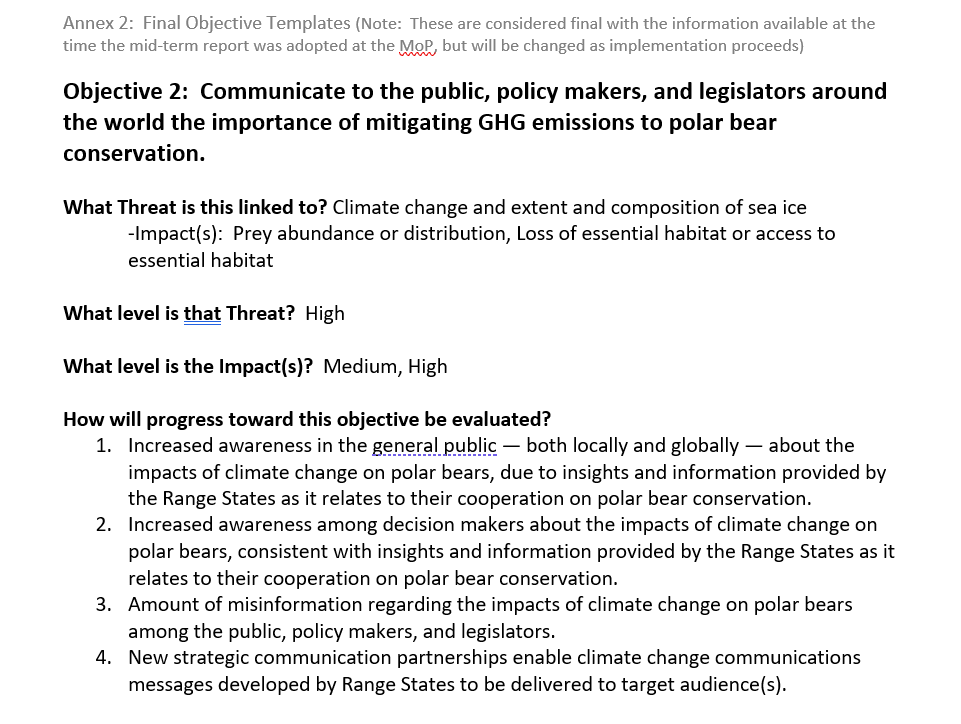
{slider title="Objective 2 - Communicate to the public, policy makers, and legislators around the world the importance of mitigating GHG emissions to polar bear conservation - (Actions 55, 59)" class="blue solid icon" open="false" mode="click"}
Objective 2, 2015-2017 Implementation Plan
{slider-sub title="Actions 55 and 59 - Communications plan & communications strategy for promoting polar bear conservation during a changing climate" class="blue icon" open="false" mode="click"}
Action 55: The Range States Comms WG will develop a communications plan for the CAP
Action 59: The Comms WG will create a report which strategically identifies appropriate messages regarding climate change threats to polar bears and the means to communicate these messages to the global audience.
Status 2017: Task for current 2-year cycle complete; will be carried into next 2-year cycle and through 2025.
Mid-Term Review updates in 2020:
The Actions were modified to the following Actions associated with Objective-2:
- CCC-A2: Develop a climate change communications plan that outlines key messages regarding the threat to the Arctic and to polar bears from climate change and the need for the global community to reduce GHG emissions.
- CCC-A3: Identify strategic communications opportunities for the Range States to provide information regarding the threat to the Arctic and to polar bears from climate change and the need for the global community to reduce GHG emissions.
- CCC-A6: Communicate key messages regarding the threat to polar bears and to the Arctic from climate change and the need for the global community to reduce GHG emissions.
{/sliders-sub}
{slider title="Objective 3 - Ensure the conservation of essential habitat for polar bears - (Actions 3, 13)" class="blue solid icon" open="false" mode="click"}
Objective 3, 2015-2017 Implementation Plan
{slider-sub title="Action 3 - Define and identify essential polar bear habitat and document change over time" class="blue icon" open="false" mode="click"}
Range States will determine the status of the identification of essential habitat for polar bear in the 19 subpopulations. Additionally, the International Union for the Conservation of Nature/Species Survival Commission (IUCN/SSC) Polar Bear Specialist Group (PBSG) will:
- Develop a suite of broad sea-ice metrics that characterize essential polar bear habitat, examine changes over time based on past observations, and project changes into the future.
- A peer-reviewed paper describing results.
- An outline for future work and a suggested work plan that would include identification of essential terrestrial habitat.
Status in 2017: Progress made in current 2-year cycle; ongoing into next 2-year cycle (pending funding).
Mid-Term Review updates in 2020:
The Action was modified to the following Actions associated with Objective-3:
- EH-A1: The PBSG will be asked to define categories of essential polar bear habitat and then compile existing information to generate an inventory of essential habitat by the categories (and identify gaps in existing information).
- EH-A5: In each biennial report, the PBSG will be asked to provide an inventory of essential habitat by the categories identified previously by the PBSG.
{slider-sub title="Action 13 - Assess the adequacy of existing oil and contaminant spill emergency response plans to protect essential polar bear habitat, and prevent polar bears from being exposed to oil" class="blue icon" open="false" mode="click"}
Each Range State will compile existing national literature. Russia will amalgamate all of the information into a circumpolar summary.
Status in 2017: Progress has been made; expect to be completed before the 2018 Meeting of the Parties (MoP).
Mid-Term Review updates in 2020:
The Action was removed from the Circumpolar Action Plan.
The implementation of the Action will partly continue at domestic/bilateral level (i.e., To assess the adequacy of existing oil and contaminant spill emergency response plans to protect essential polar bear habitat).
{/sliders-sub}
{slider title=" Objective 4 - Ensure that harvest of polar bear subpopulations is managed in a biologically sustainable manner in accordance with sound conservation practices - (No Action)" class="blue solid icon" open="false" mode="click"}
Objective 4, 2015-2017 Implementation Plan
Objective 4 Actions: None
{slider title="Objective 5 - Manage human-bear interactions to ensure human safety and to minimize polar bear injury or mortality - (Actions 7, 22)" class="blue solid icon" open="false" mode="click"}
Objective 5, 2015-2017 Implementation Plan
{slider-sub title="Action 7 - Develop strategies for responding to the potential for large numbers of bears stranded on shore near communities and human developments and consider the consequences including those for human safety and transmission of disease between bears" class="blue icon" open="false" mode="click"}
A report will be prepared which summarizes the existing information on strategies for addressing large numbers of bears stranded on shore near communities and human developments, and the risks to human safety. The report will, if possible, identify the geographic areas where the likelihood of such events is higher.
Status 2017: Ongoing for current 2-year cycle; will be carried into next 2-year cycle.
Mid-Term Review updates in 2020:
The Action was modified to the following Actions associated with Objective-5:
- HBC-IS1: Share information related to strategies for responding to the potential for large numbers of bears stranded on shore near communities and human developments and consider the consequences including those for human safety.
{slider-sub title="Action 22 - Reduce the risk of injury and mortality to humans and bears as a result of their interactions by:" class="blue icon" open="false" mode="click"}
a. continuing to support the work of the Range State Conflict Working Group;
b. implementing and making available to all Range States the Polar Bear-Human Information Management System (PBHIMS);
c. developing and implementing appropriate data-sharing agreements among the Range States and making the data available to Range State management authorities;
d. entering all available data on human-bear interactions into the PBHIMS database on an ongoing basis; and
e. developing BMPs on tools and techniques for use in preventing and mitigating human–bear conflicts
Status in 2017: Partially complete in current 2-year cycle; will be carried into next 2-year cycle.
Mid-Term Review updates in 2020:
The Action was modified to the following Actions associated with Objective-5:
- HBC-A1: Make available to all Range States the Polar Bear-Human Information Management System (PBHIMS); use SMART where possible.
- HBC-IS3: Collaborate and share information on applied research and testing of new deterrent tools (i.e., drones, olfactory, electric fences) on wild and captive bears.
{/sliders-sub}
{slider title="Objective 6 - Ensure that international trade of polar bears is carried out according to conservation principles - (Action 12)" class="blue solid icon" open="false" mode="click"}
Objective 6, 2015-2017 Implementation Plan
{slider-sub title="Action 12 - Polar Bear Range States’ Trade Working Group recommendations" class="blue icon" open="false" mode="click"}
Implement the six recommendations adopted by the Range States based on completion of the Trade Working Group project International Cooperation for Better Enforcement, Reporting and Data for Polar Bears to fulfill the statements set forth in the Declaration of the Responsible Ministers of the Polar Bear Range States to counter threat of poaching and illegal trade and to strengthen international cooperation to improve the clarity of legal trade data.
Status in 2017: Partially complete in current 2-year cycle; will be carried into next 2-year cycle.
Mid-Term Review updates in 2020:
The Action was removed from the Circumpolar Action Plan.
{/sliders-sub}
{slider title="Objective 7 * - Carry out coordinated circumpolar population research and monitoring that addresses achieving the objectives and providing information to help make progress toward the vision and monitor progress toward the vision of the CAP - (Actions 27, 29)" class="blue solid icon" open="false" mode="click"}
Objective 7, 2015-2017 Implementation Plan
{slider-sub title="Action 27 - Inter-jurisdictional collaboration in support of consistent research methods and data sets for polar bears" class="blue icon" open="false" mode="click"}
Researchers from the Range States will endeavor to develop and apply, where appropriate, common research techniques and data reporting. This will be achieved, for example, through the IUCN/SSC PBSG, exchange among research personnel of the Range States, and other forums.
Status in 2017: Progress has been made in current 2-year cycle; will be carried into next 2-year cycle and through 2025.
Mid-Term Review updates in 2020:
The Action was modified to:
- PRM-A2: Share research plans among jurisdictions to encourage consistency of methods and data - associated with a new CAP Objective-7: Carry out coordinated circumpolar population research and monitoring that addresses achieving the objectives and providing information to help make progress toward the vision and monitor progress toward the vision of the CAP
{slider-sub title="Action 29 - Determination of population size estimates as per the Inventory Schedule" class="blue icon" open="false" mode="click"}
Subject to priorities, each Range State will conduct population assessments as per the CAP Inventory Schedule (Appendix V).
Status in 2017: Progress has been made in current 2-year cycle; will be carried into next 2-year cycle and through 2025.
Mid-Term Review updates in 2020:
The Action was modified to:
- PRM-A3: Obtain population size estimates for all 19 subpopulations of polar bears according to the inventory schedule provided in this Plan (see Appendix V) - associated with a new CAP Objective-7: Carry out coordinated circumpolar population research and monitoring that addresses achieving the objectives and providing information to help make progress toward the vision and monitor progress toward the vision of the CAP
{/sliders-sub}
{/sliders}
* Objective-7 was added as a new CAP Objective in 2020.
List of other Actions of the CAP 2015 - 2017 implementation plan*:
{slider title="Best Management Practices - (Actions 17, 18, 19)" class="blue solid icon" open="false" mode="click"}
- Mineral and energy resource exploration and development:
{slider-sub title="Action 17 - Operations, Protocols, and Procedures of the Range States" class="blue icon" open="false" mode="click"}
Explore and develop options for making the operations of the Range States more standardized and/or formal. A working group will be created to develop options for consideration by the Range States in 2017. Options should include a full range from formally adopting rules of procedure and protocols to consideration of a Secretariat, and associated costs and funding options to implement the CAP.
Status in 2017: Progress has been made in current 2-year cycle; options will be presented at the 2018 MoP.
Action-17 Progress Report for the 2015-2017 Implementation Plan period
Mid-Term Review updates in 2020:
The Action was removed from the CAP but continued as an ongoing PBRS activity.
{/sliders-sub}
- Contaminants and Pollution:
{slider-sub title="Action 18 - Determine priority research needs considering the monitoring framework, national mandates and funding options" class="blue icon" open="false" mode="click"}
IUCN/SSC PBSG to consider all the science-related actions in the CAP and to prioritize them into two and ten year actions with a report back to the Range States for their consideration. The report will include possible funding sources and applications will have been made, where appropriate.
Status in 2017: Progress has been made in current 2-year cycle; will be carried into next 2-year cycle.
Action-18 Progress Report for the 2015-2017 Implementation Plan period
Mid-Term Review updates in 2020:
The Action was removed from the CAP but continued as an ongoing PBRS activity.
{/sliders-sub}
- Tourism and Related Activities:
{slider-sub title="Action 19 - Continue to support the work of the Range States Conflict Working Group (CWG)" class="blue icon" open="false" mode="click"}
Each Range State will identify key tourism operators and engage in discussions with them about their current practices to minimize the impacts of their activities on polar bears and the risk to humans of tourism in areas where polar bears are present.
Status in 2017: Progress made in current 2-year cycle; will be combined with action #20 and carried into next 2-year cycle.
Mid-Term Review updates in 2020:
The Action was removed from the Circumpolar Action Plan.
{/sliders-sub}
{slider title="Monitoring and Research - (Actions 33, 34, 35)" class="blue solid icon" open="false" mode="click"}
- Obtain Information on all Polar Bear Subpopulations:
{slider-sub title="Action 33 - Annual population assessments for each of the polar bear subpopulations" class="blue icon" open="false" mode="click"}
Population assessments of all 19 subpopulations will be conducted on an annual basis for each of the subpopulations. If there is no new information the assessment for an individual subpopulation may remain unchanged from the previous year. The assessment reports will be made generally available in a timely manner.
Status in 2017: Progress has been made in current 2-year cycle; will be carried into next 2-year cycle and through 2025.
Mid-Term Review updates in 2020:
The Action was removed from the Circumpolar Action Plan.
{slider-sub title="Action 34 - Obtaining Traditional Ecological Knowledge (TEK) for each subpopulation" class="blue icon" open="false" mode="click"}
Subject to priorities each Range State will compile TEK for each subpopulation as per the CAP Acquisition Schedule (Appendix VI).
Status in 2017: Task for current 2-year cycle expected to be approved at the 2018 MoP; will be carried into next 2-year cycle and through 2025.
Mid-Term Review updates in 2020:
The Action was removed from the CAP but continued as an ongoing PBRS activity.
{slider-sub title="Action 35 - Establishment of a Range State definition of TEK and guidelines for the use of TEK in management decisions" class="blue icon" open="false" mode="click"}
A TEK Working Group (Canada, Greenland, United States and Russia) will be formed and will work to establish an agreed-upon definition of TEK. The TEK Working Group (WG) will then work to establish guidelines for the Range States for including TEK in management decisions. The TEK WG will consider legal requirements in each Range States and the language of the Agreement on the Conservation of Polar Bears.
Status in 2017: Task for current 2-year cycle expected to be approved at the 2018 MoP; task may be carried into next 2-year cycle and through 2025.
Mid-Term Review updates in 2020:
The Action was removed from the CAP but continued as an ongoing PBRS activity.
{/sliders-sub}
{slider title="Communications and Outreach - (Action 53)" class="blue solid icon" open="false" mode="click"}
{slider-sub title="Action 53 - Maintenance of website established for 2015 Range State meeting and establishment of a permanent Range State website" class="blue icon" open="false" mode="click"}
A Range States Communications Working Group (Comms WG) will be created to develop a website and long-term funding plan for the related costs. The existing website for the 2015 Range States Biennial Meeting of the Parties (MoP) will be maintained until a permanent solution is in place. The permanent website will be in place on December 1, 2017.
Status in 2017: Task will be partially complete Dec. 1, 2017; will be carried into next 2-year cycle and through 2025.
Mid-Term Review updates in 2020:
The Action was partly modified to:
- CCC-A4: The Maintain a climate change communications page on the RS website - associated with CAP Objective-2
{/sliders-sub}
{slider title="Performance Measurement - (Actions 60, 61, 63)" class="blue solid icon" open="false" mode="click"}
{slider-sub title="Action 60 - Biennial reviews based on Table 4 of the CAP" class="blue icon" open="false" mode="click"}
The CAP Implementation Team (IT) will develop a biennial report which will include national updates as well as a progress report on actions related to the Plan. The reports will be posted on the website shortly before each Range States Biennial Meeting of the Parties MoP.
Status in 2017: Task partially complete Dec. 1, 2017, remaining task for current 2-year cycle expected to be approved at the 2018 MoP; will be carried into next 2-year cycle and through 2025.
{slider-sub title="Action 61 - Establish baselines for measurement of action plan performance" class="blue icon" open="false" mode="click"}
The CAP IT will develop baseline values for all the agreed indicators of the performance measurement system of the plan. It is important to note that this concerns baseline values of the indicators of success of the CAP, not scientific baselines values pertaining to specific research or monitoring activities in the plan. These baseline values will document the current situation for the targets or activities that the different actions in the plan address and serve as the starting point for measuring progress.
Status in 2017: Task expected to be completed before the 2018 MoP.
{slider-sub title="Action 63 - Explore methods for improving the design of improving polar bear population studies" class="blue icon" open="false" mode="click"}
IUCN/SSC PBSG to develop recommendations for improving the design of population studies/assessments in order to increase the efficiency of how resources are utilized.
Status in 2017: Progress has been made in current 2-year cycle; will be carried into next 2-year cycle.
Mid-Term Review updates in 2020:
The Action was removed from the Circumpolar Action Plan.
{/sliders-sub} {/sliders}
* The 'other' Actions have a general connection to the CAP and cannot be associated with a specific Objective. The categorization applied in this list follows the categories used in the original CAP.
(Source: (2015). See also (2020); and ).